
(how) do we last?
building on Peter W. Zapffe's care for existentialism

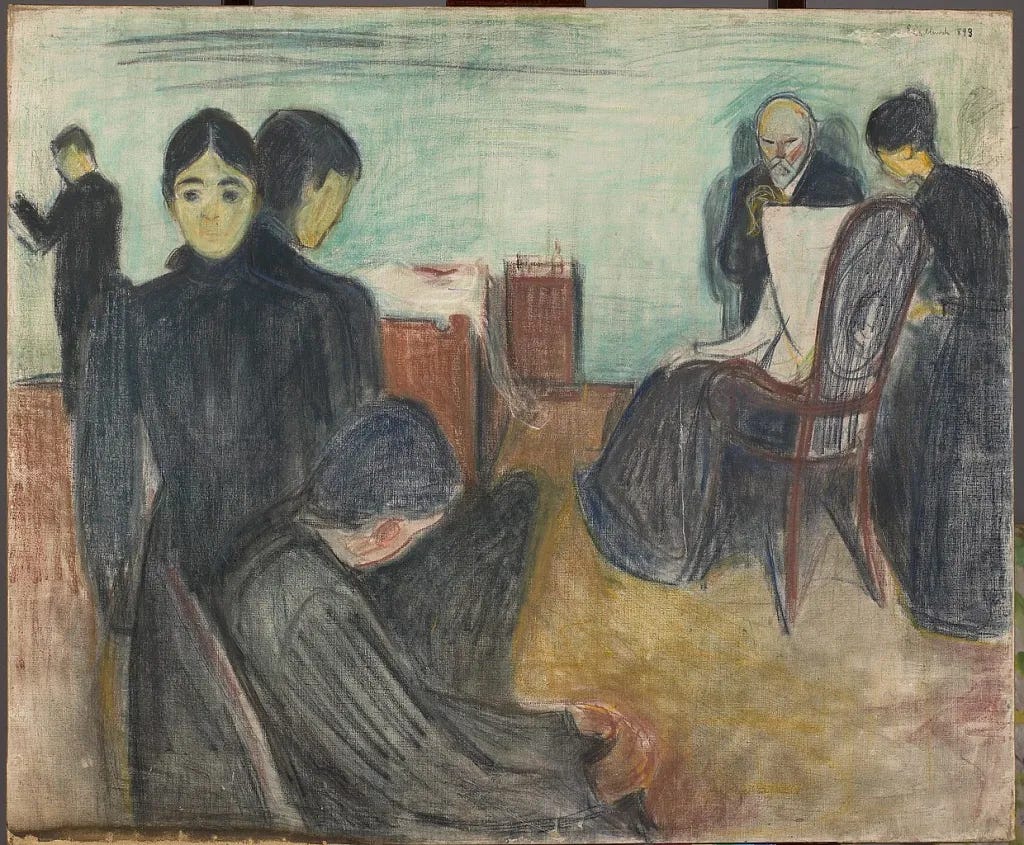
The knowledge of tragedy’s inevitability is too much for the human kind to acknowledge.
Most people learn to save themselves not by confronting the world as it ‘is’, but by carefully trimming the borders of their own consciousness. It is an ancient art: soft, instinctive (almost invisible?) where the mind repurposes reality like a trembling censor, cutting away what threatens its fragile coherence.
As such, how do we, as a species, already tend to survive ourselves?
We begin with isolation. It is a retreat conducted not only in physical space but within the mind’s own corridors. A hush of unconscious ignorance. The refusal to linger on existential questions that singe the fingertips.
Do we think? Not. Do we ask? Not. Do we probe? Not.
We simply fold into self, shielding the psyche from the horrific truths that linger just beneath the floorboards of ordinary life. This, mere speck, must not be mistook as peace. ‘Tis but a soft cocoon woven from self-sheltering denial.
And then, there’s anchoring. We fasten ourselves to ritual, tradition, institution, inherited systems of belief: any structure sturdy enough to feel like a handrail.
Such attachment offers the illusion of guidance, a comforting sense that someone before us mapped the terrain. It is a collective agreement to trust what has already been trusted. Survival hinges on steadying ourselves on lore we did not write but desperately require.
As if this sense of belonging was not enough, next arrives distraction. Humanity’s most flamboyant coping ritual. We clutter the mind with tasks, errands, chatter, engulfing screens, compulsions. These (menial) occupations become a shield against the cathartic clarity of awareness.
To stay busy is to dodge care. To dodge care is to stay safe (or so we hope). And in doing so, we avoid both harm and accountability.
We end up drifting on the surface of life rather than being pulled into its undercurrents.
And now, we must brace for the final fourth: sublimation. The most elegant and dangerous of the four. Here anxiety becomes art. Pain is transfigured into something glorious, expressive, even novel.
It’s akin to smuggling despair across the border of beauty; disguising it in aesthetics, channeling it into creation.
Sublimation as a mechanism feels the closest to transcendence. Yet, just as the other three, it is a translation rather than the truth.
But for all their ingenuity, each of the above is temporary. They demand constant maintenance, like fragile machinery humming just on the edge of collapse. They do not reach the root cause of suffering. It is merely a means of rearranging the furniture around it.
We defend ourselves through self-denial, a choreography of avoidance refined across millennia.
Therefore we arrive at the fundamental dilemma: a species torn between the desire to continue pursuit and the desire to decipher. Between the instinct for survival and the burden of awareness.
What do we seek? Purpose, solace, redemption. And yet we suspect these are scaffolds erected to protect us from the void. The binaries implode within us. When we see through this illusion, we arrive at liberation and condemnation at once.
For those seeking a conclusion, perhaps the way forward is not resolution at all, but the cessation of dependency on resolution. A surrender, not in defeat but in recognition. To welcome our condition, our aimlessness, our unsteady belonging in a universe that owes us nothing.
Now, we may call this nihilism. Or we may recognize this as the beginning of a transformation: not as escape, but as acceptance. A creative living-with the human condition, rather than a running-from it.
In that tender, raw, unadorned embrace, may we finally find something resembling equilibrium.